
Creator tools · Local software
Local tool · In developmentCreator Analytics Hub
Built for Yi Zhou's own publishing workflow: a local workspace that brings multi-platform accounts, content history, and review into one place while keeping data gaps visible.
The starting point
Problem & product concept
Yi Zhou publishes on multiple platforms. He found it inconvenient to open each platform's creator dashboard separately, so he wanted to bring the data together for easier viewing and review. The local tool keeps account scope, observation dates, platform definitions, and missing history visible.
Yi Zhou’s contribution
Yi Zhou identified the problem through his own content work and defined the combined viewing and review workflow. He also requested an entry inside his existing personal website restricted to its highest-permission owner. Project handoffs document his access requirements and participation in diagnosing failed remote access. AI/Codex implemented the application and integration; this case does not attribute all code or statistical decisions to him.
Working with AI
The project is presented as AI-assisted development under Yi Zhou's product direction. Current source establishes that the modules exist; it does not prove which person manually wrote a given line or independently verify historical platform checks.
A specific challenge
A successful synchronization is not the same as good data
What surfaced
Missing history, expired authentication, different platform definitions, and delayed snapshots can make a clean-looking dashboard misleading.
The response
Inspected source has explicit unknown-freshness handling, historical-coverage calculations, account-scoped synchronization states, and a serial scheduler. Stored observations and deterministic review calculations are separate from live collection.
What this illustrates
A useful analytics tool needs to explain the age, scope, and limits of its data alongside the numbers.
Technical lesson drawn from the evidence. Yi Zhou’s personal reflection is being documented in his own words.
How the system is organized
Python application modules use a local SQLite-backed repository. Platform adapters feed account-scoped content and snapshots. Separate review, scheduler, and health modules organize analysis and synchronization. Website and plugin handoffs describe a server-side proxy, per-request owner authorization, and a read-only remote viewer; that website is separate from this portfolio. No private database or session file is included here, and the remote path was not tested in this review.
Account-scoped data flow
- Creator
- Account
- Content
- Snapshot
- Review
Synchronization and quality
- Serial queue
- Adapter
- Stored observation
- Freshness + coverage
- Account-scoped records
- Creators, accounts, content, and time-stamped observations retain separate identities.
- Local review
- Deterministic review calculations use stored observations rather than generating an AI performance narrative.
- Synchronization health
- A serial scheduler, authentication-required states, freshness, and coverage describe collection status.
- Personal website access
- A separate personal website proxies owner-authorized, read-only pages and exports to the local tool. Local administration and collection remain independent.
Decisions that shape the work
- Keep platform source values separate from normalized metrics.
- Preserve account boundaries and expose missing history.
- Distinguish a completed sync from genuinely fresh, sufficiently covered data.
Evidence & verification
Source inspection, local interface observations, historical reports, and applicant-supplied accounts establish different things. The labels below keep those boundaries visible.
Repository and application modules
Local application, account/content repository, deterministic review engine, synchronization scheduler, and health calculations were inspected without executing collectors.
Actual local interface, 29 October 2026
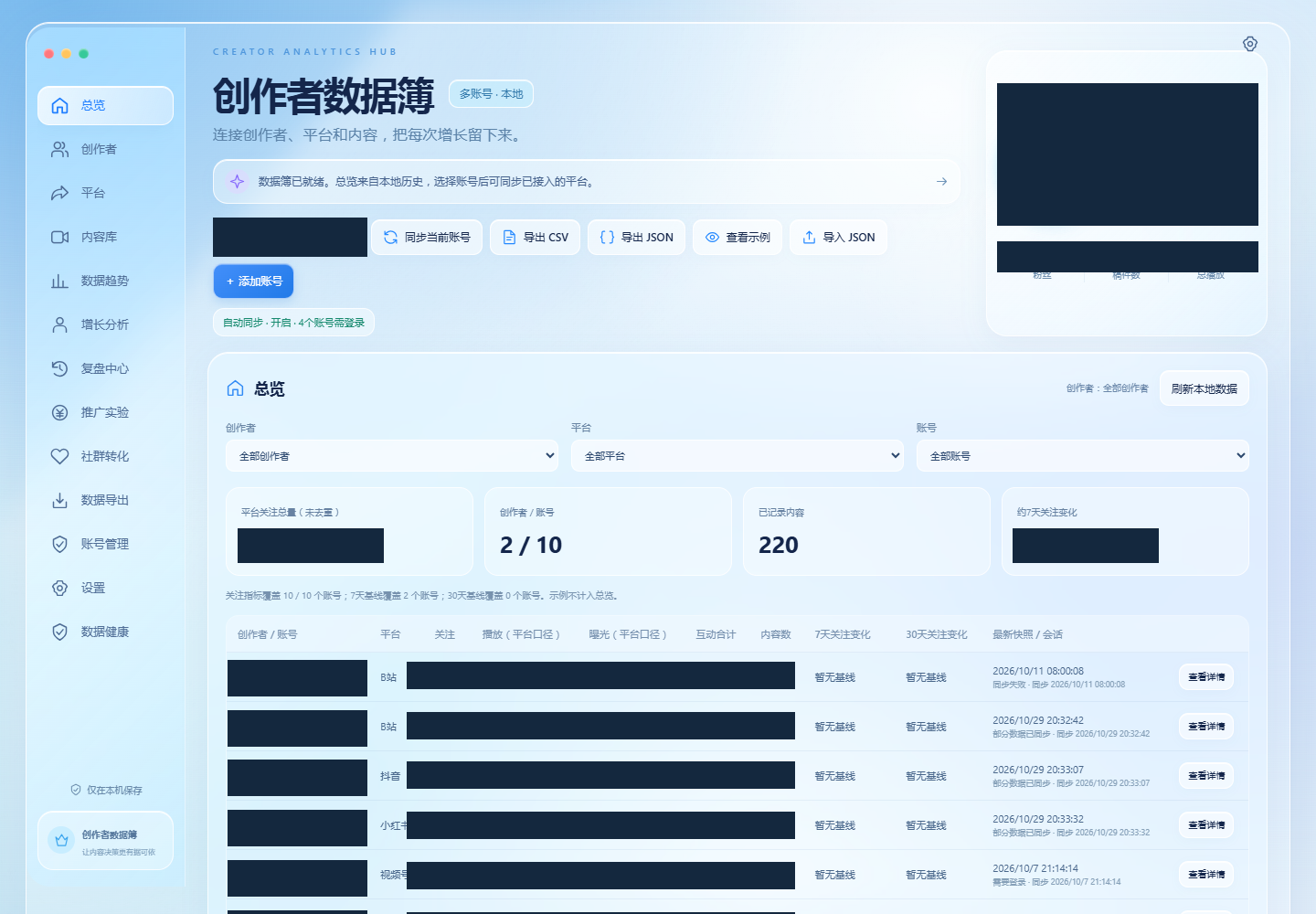
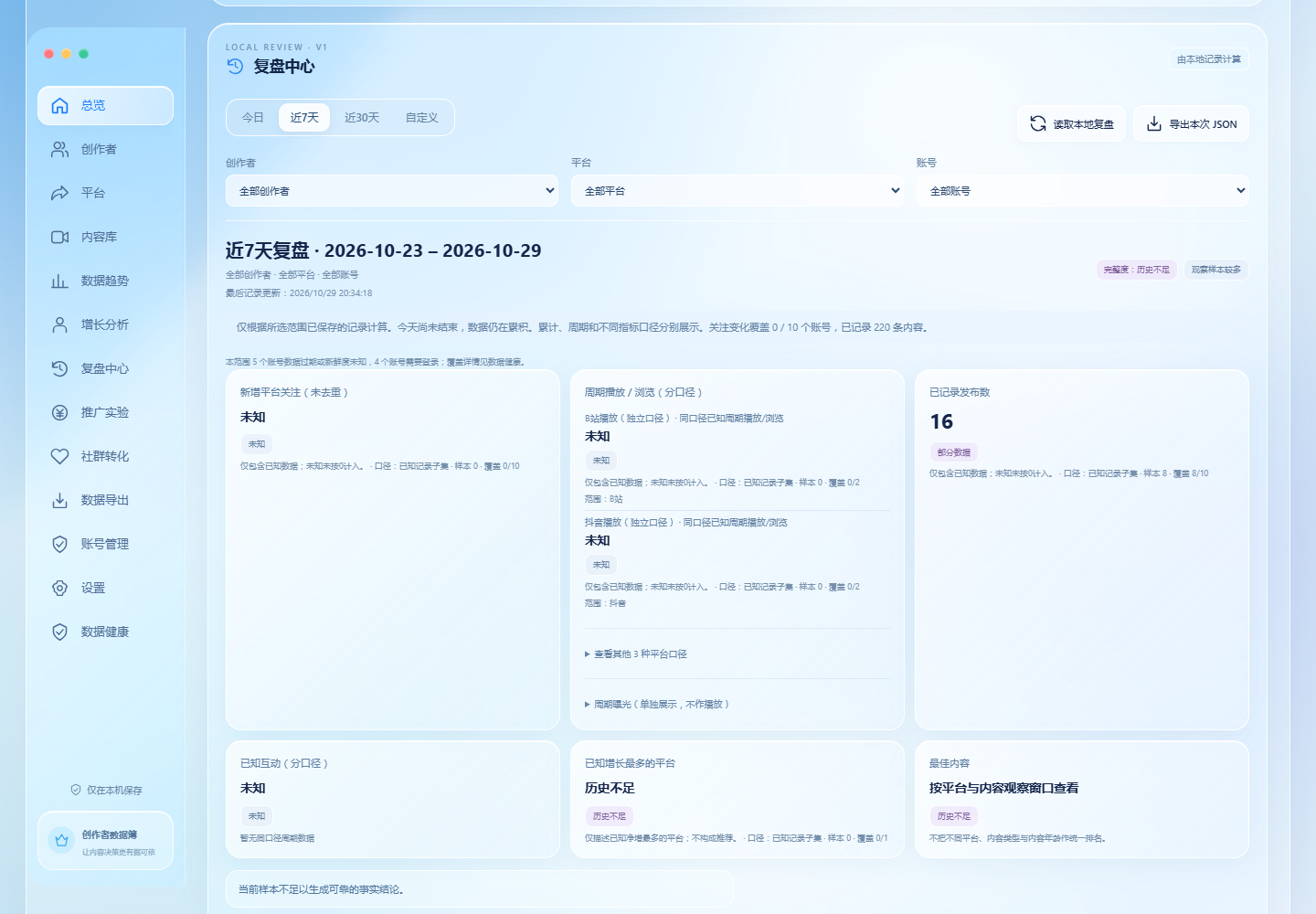
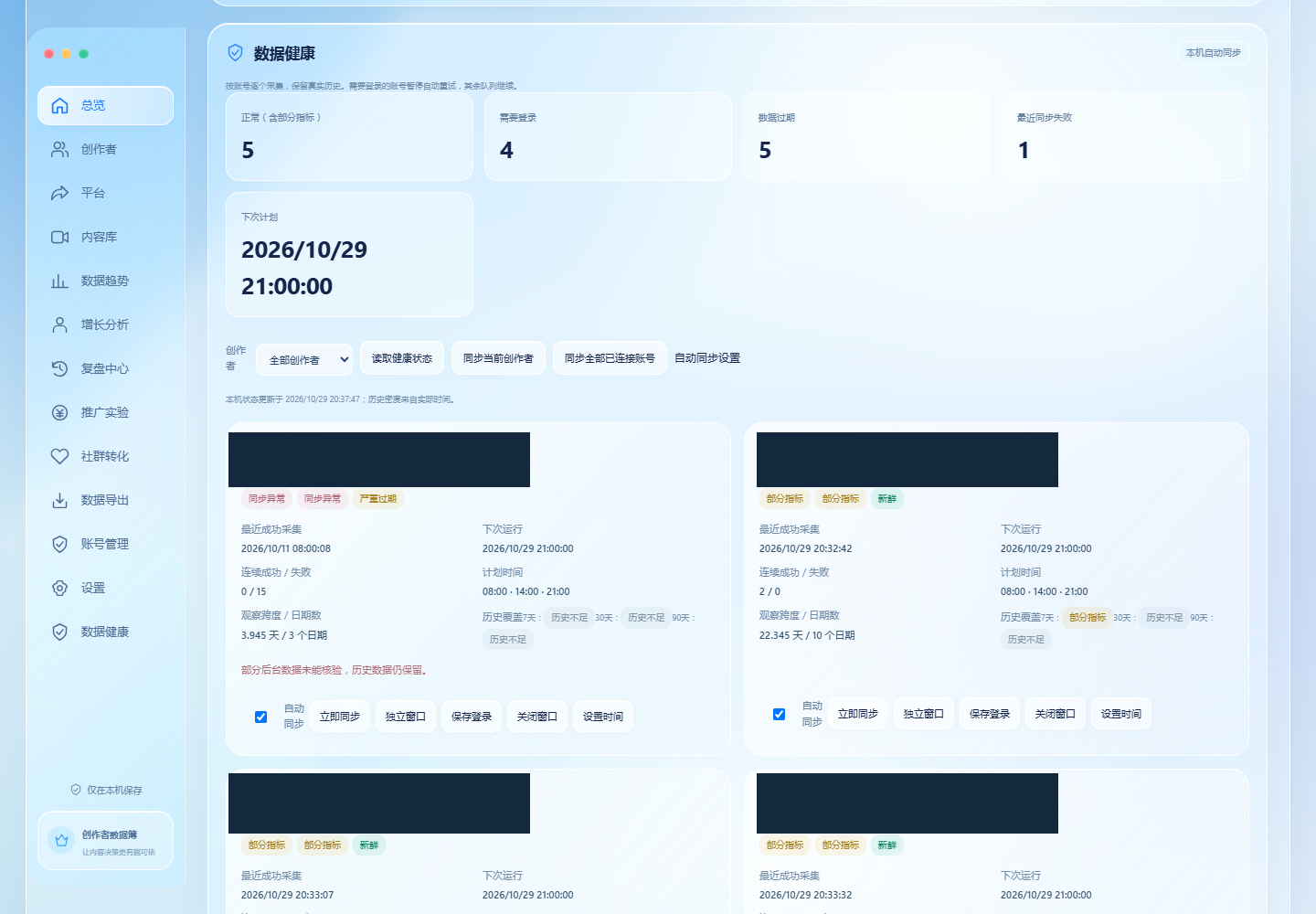
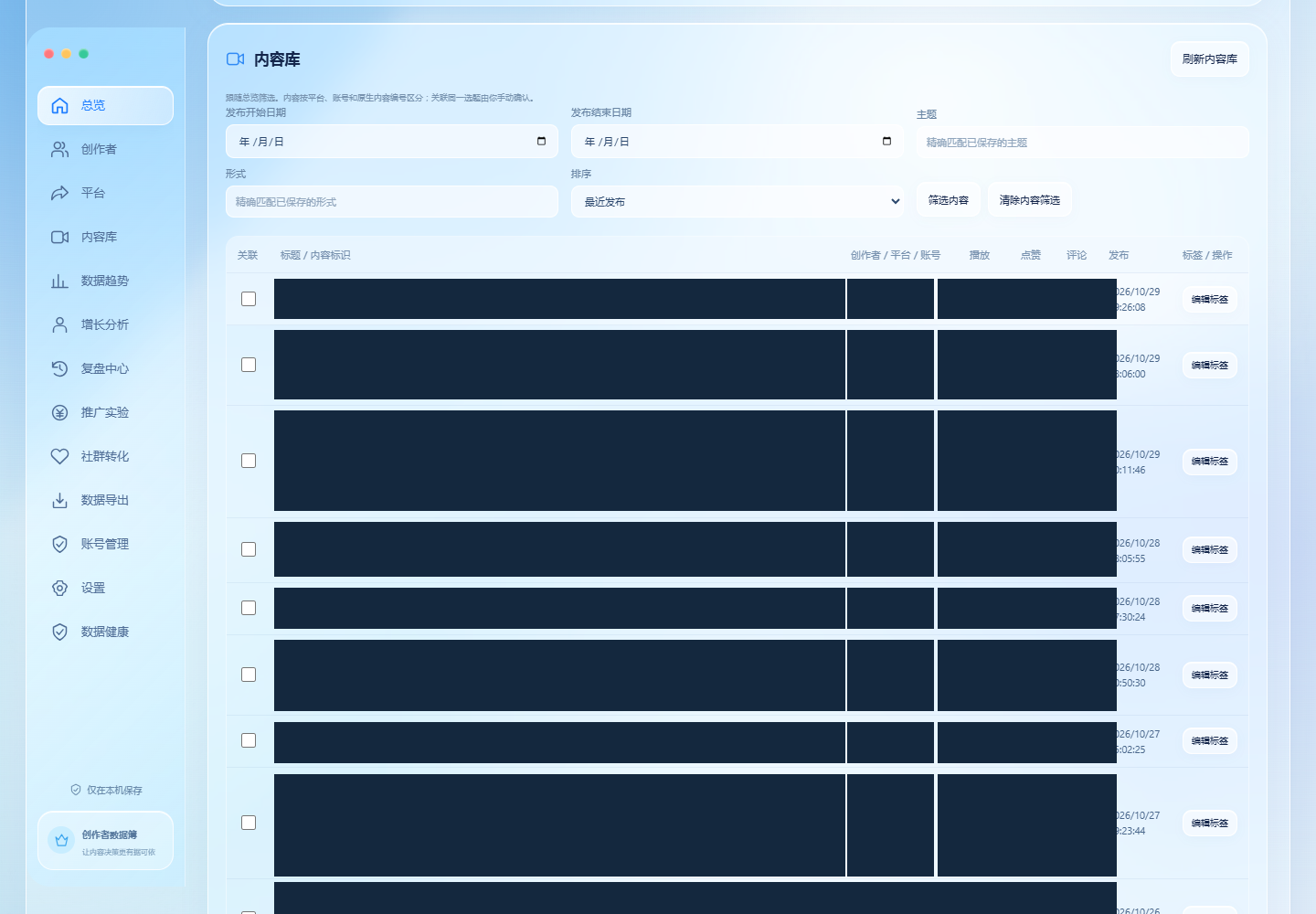
The running local tool was opened in Chromium. Overview and content records were displayed; saved-record review and health views were loaded. Four screenshots preserve unknown, partial, stale, and failed states. No sync, login, import, export, or settings change was initiated.
Separate personal website integration
Website and plugin handoffs independently describe owner-restricted remote reading through a server-side proxy, with local management kept separate. Historical page recovery is reported; current remote stability and full mobile acceptance remain unverified.
Historical integration reports
Documentation reports account and platform checks. No account was logged into, synchronized, or independently retested during this portfolio work; historical test counts are not repeated as fresh results.
Integration limits
Documentation marks YouTube and X as in development and describes partial domestic-platform integrations. These are not represented as approved OAuth integrations or guaranteed continuing access.
An honest boundary
Current maturity & limitations
- Screenshots show saved local observations, not a new platform-collection test. Identities, private audience values, titles, and content identifiers are hidden with opaque masks.
- The observed seven-day review lacks sufficient comparable history for reliable growth conclusions; missing values were not converted to zero.
- Current platform connectivity and session persistence were not independently verified.
- Personal website remote access has historical stability issues; the local screenshots do not verify remote authorization, current availability, or mobile acceptance.
- Platform-internal authenticated requests are not equivalent to an approved public OAuth integration.
- Audience deduplication, causal attribution, and a demonstrated content-growth or revenue effect are not established.