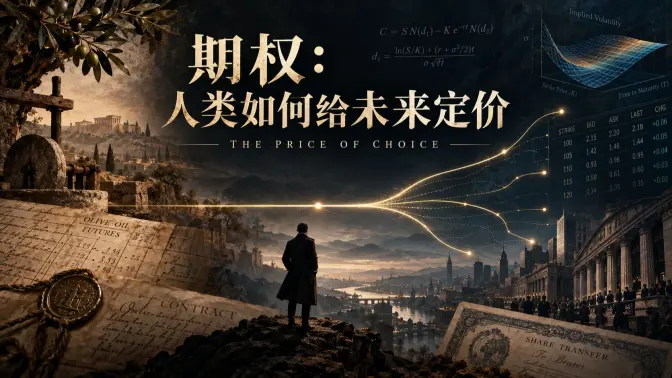
A brief history of options
《期权简史》:从古希腊到华尔街,人类如何给未来定价?
A Mandarin explainer tracing the history of options from ancient Greece to modern financial markets.
Watch on Bilibili (opens in a new tab)Films & making process
Yi Zhou develops topics, reviews content, directs visuals and characters, and iterates on films made with AI coding tools.
Two films from his personal channel. Their public pages were inspected on 29 October 2026 and displayed AI-generated-content disclosures. Playback opens on Bilibili.
《期权简史》:从古希腊到华尔街,人类如何给未来定价?
A Mandarin explainer tracing the history of options from ancient Greece to modern financial markets.
Watch on Bilibili (opens in a new tab)
「Vibe知识大赏」区块链诞生前,人类花了几十年解决“信任”
A Mandarin explainer about the ideas in cryptography and digital trust that preceded blockchain.
Watch on Bilibili (opens in a new tab)The public pages establish published examples. Specific source projects and production steps for these two films are still being matched; the country-guide implementation below is a separate example.
A separate series introduces countries and universities. Yi Zhou confirmed responsibility for topics, content review, visual and character direction, revision requests, and final review. His mother handles uploading those country-guide films to social media.
Project records attribute three review requests to Yi Zhou: remove an uncanny hand treatment, take the series label out of the opening, and remove the subtitle backing panel.
The V3 implementation places the handbook on a wooden tabletop without hands, omits the opening label while retaining it in the body, and renders subtitles with a thin contrasting halo instead of a backing panel.
The final Japan export is 1920 × 1080 at 30 fps, approximately 8 minutes 40 seconds. Its file hash matched the 24 October approval record when checked on 29 October. Four selected frames were reviewed; that inspection did not repeat the historical full-film or audio checks.
The country-guide work includes generated illustrations, code animation, and synthetic narration. Content review describes Yi Zhou’s role; it is not a credential or a guarantee that every educational or financial statement is independently verified. No growth, revenue, or production-time improvement is claimed.
The portfolio links to published work and describes the inspected workflow. It does not rehost the original films, raw prompts, research dossiers, or third-party visual assets. Yi Zhou plans to connect this series with Iapetus; a completed technical integration has not been verified.
Read the production evidence note