
Education · Discovery and information
Public preview · In developmentIapetus Education Platform
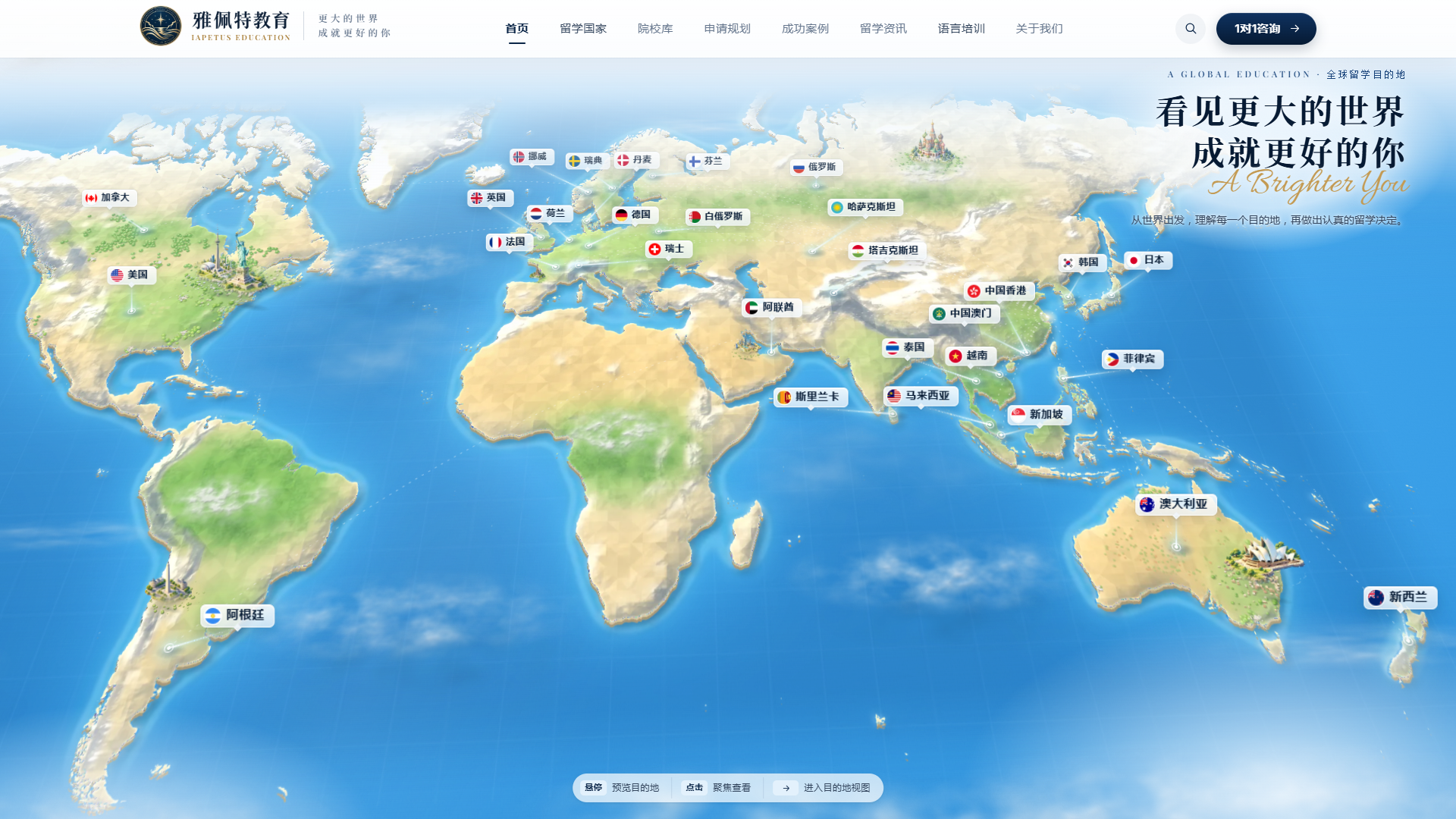
A website Yi Zhou built for Iapetus Education’s study-abroad work. The public preview opens with an interactive map for exploring destinations.
Visit project websiteThe starting point
Problem & product concept
The intended product brings destination exploration, university information, and the wider application journey into a coherent experience. Its design challenge is to keep an engaging interface separate from claims that need sources, review, and permission to publish.
Yi Zhou’s contribution
Yi Zhou describes work on product direction, frontend design review, backend architecture discussions, data, and quality assurance. These personal activities are applicant-reported. The repository independently supports the existence of separate visual, architecture, research, and QA workstreams; it does not prove exclusive authorship.
Working with AI
Yi Zhou's product and experience direction is applicant-reported. Existing governance describes Claude-assisted visual/frontend work and Codex-assisted platform, architecture, data, and QA work. This portfolio does not attribute every implementation decision or line of code to Yi Zhou.
A specific challenge
An immersive prototype must not become a source of truth
What surfaced
A polished destination interface can make provisional content look authoritative. The inspected visual source imports mock data, while research and architecture have separate review states.
The response
Project governance explicitly separates prototype content from factual publication. The visual implementation is identified by its branch, and architecture/research readiness is described independently. This case publishes no university dataset, fees, rankings, admissions rules, or private research packet.
What this illustrates
Product quality includes knowing what the interface can demonstrate and what the underlying evidence does not yet establish.
Technical lesson drawn from the evidence. Yi Zhou’s personal reflection is being documented in his own words.
How the system is organized
Inspected frontend source contains a Next.js world-overview component, a camera/state transition model, destination routes, reduced-motion handling, and mock-content imports. Canonical architecture documents propose separate presentation, domain, data-access, and provenance responsibilities. Those proposals are not a deployed backend.
Implemented prototype interaction
- World overview
- Destination focus
- UK destination prototype
Proposed information boundary
- Sources
- Domain records
- Reviewed view models
- Presentation
- Visual prototype
- A world overview, destination focus interaction, and UK destination prototype exist on a visual branch.
- Architecture and contracts
- The canonical documentation describes domain boundaries and source governance; detailed mechanisms remain proposals.
- Research review
- Research packets preserve source and use limitations. Their presence does not authorize public factual display.
Decisions that shape the work
- Keep prototype content distinct from verified factual records.
- Separate factual information, third-party rankings, editorial discovery, and personal relevance.
- Treat visual implementation, canonical integration, and public release as distinct milestones.
Evidence & verification
Source inspection, local interface observations, historical reports, and applicant-supplied accounts establish different things. The labels below keep those boundaries visible.
Visual implementation
World-overview source, camera transitions, destination routing, reduced-motion handling, and mock imports exist on the visual branch. Existing uncommitted work was preserved; no runtime validation is claimed.
Canonical architecture and governance
Source/publication boundaries and separate treatment of rankings, editorial discovery, and relevance are documented. Detailed architecture remains proposed and research is not approved for public reuse.
Future complete platform
Production integration, operational backend services, and a fully verified public information platform remain outside the evidence established for this case.
An honest boundary
Current maturity & limitations
- The linked homepage was accessible on 4 November 2026. The source review covers earlier project snapshots.
- Canonical main and the frontend worktree contain different implementation scopes.
- Visual source includes mock content. Its appearance does not verify admissions, policy, cost, or ranking facts.
- No restricted university research, third-party rankings, or original internal governance files are republished.
- The public check covered homepage access and visible content. Performance and end-to-end functionality remain unverified.